Barbara Gschaider
Violin maker based in Bonn, Germany. Her work focuses on contemporary violas and baroque string instruments, inspired by the great historical makers while guided by the needs of today's musicians.
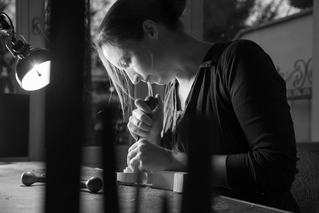
Areas of Expertise
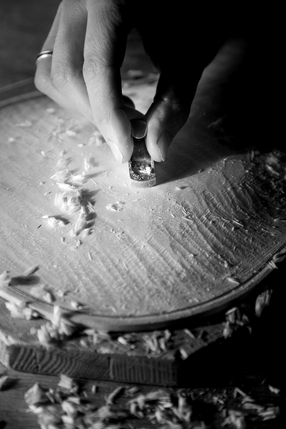
Why so many Violas?
Well, I am asking myself another question: why would anyone make violins when they could be making violas?
My passion for the viola is closely connected to my own musical background. I have been a violist from the very beginning, and it has always been the instrument I feel most at home with.
Years ago, when I started out as a violin maker, I decided to take violin lessons. I thought that, as a violin maker, I ought to be able to play the violin as well. Despite having a wonderful teacher, however, I never really bonded with the instrument.
What I discovered was that the violin and the viola are fundamentally different. They demand different techniques, a different musical approach and, perhaps, even a different players personality.
The same is true in the workshop. A viola is not simply a larger violin; it is an instrument in its own right. Its proportions, arching and plate graduations must be approached differently. Many things we learnt about how to make a violin sound well simply do not work on a viola. Unlike the violin, it was not designend to be used as a solo instrument, so hardly any old model meets the demands of modern players. This leaves room for exploration and development, which I find far more rewarding than simply reproducing the great violin models of the past.
After a year, I decided to give up my violin lessons. They were not without their benefits, though: by the end of the year, my violin teacher added the viola to her repertoire.
Baroque
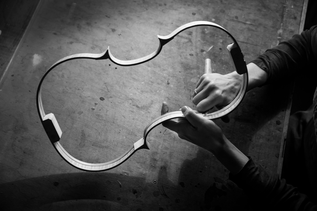
While I rarely make modern violins today, I still very much enjoy building baroque violins. In many ways, they raise the same questions that first drew me to the viola. Like the viola, the baroque violin works with considerably lower string tension. Keeping the instrument light without sacrificing stability is therefore one of the central challenges. Many of the ideas I have developed while building violas have proved equally valuable when making baroque instruments.
Like the viola, the baroque violin leaves room for interpretation. Unlike modern violins, they were never standardised to the same extent. Relatively few original examples have survived, leaving many questions unanswered. That leaves room for research, experimentation and, ultimately, for better instruments.
Journey
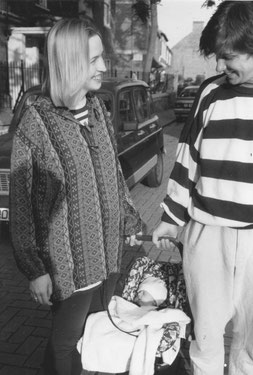
Early Days: The Newark School of Violin Making
We met at the Newark School of Violin Making where we spent four years: Three in the violin making course and one year specialising in baroque instruments. We graduated in 1996.
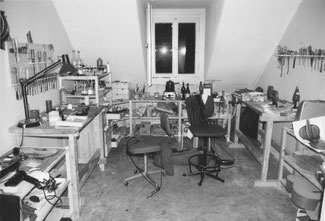
Our first workshop
Three years later, after gaining experience in several established workshops, we opened our own workshop in a small attic room. Space was limited and money was scarce, but we were full of enthusiasm — and our customers must have been, too: the attic was on the 5th floor on an old building without an elevator.
Today
Our baby has grown up, the attic room has changed into a large groundfloor workshop and our instruments are played in several European countries.
Our enthusiasm for violin making has only grown stronger over the years. It is a privilege to work in a profession where experience continually deepens both skill and understanding. It is no coincidence that Stradivari's most celebrated instruments were made during his Golden Period, between 1700 and 1725, when he was approximately fifty to seventy-five years old.
For us, learning never stops. We regularly attend international workshops and specialist courses, covering subjects ranging from cooking traditional Cremonese varnish and new materials for bow repair to advanced restoration techniques for valuable historical instruments. Exchanging ideas with colleagues from around the world continually broadens our perspective and often inspires new approaches that find their way directly into our everyday work.