Suitable for period Violins and Violas
Choosing the Right Model
Building for Lower String Tension
One of the challenges of building a successful baroque violin is its relatively low string tension. Building an instrument that responds freely under these conditions requires a different approach to arching, weight and flexibility than building a modern violin.
Another essential aspect is keeping the instrument as light as possible. A lighter construction allows the instrument to respond more quickly and naturally to the articulation and bowing techniques of the Baroque period, while preserving warmth and richness of tone.
Achieving the right balance between strength, flexibility and weight begins with choosing the right model. To understand our approach, we invite you to look at violin construction through the eyes of a violin maker.
Understand the Arching
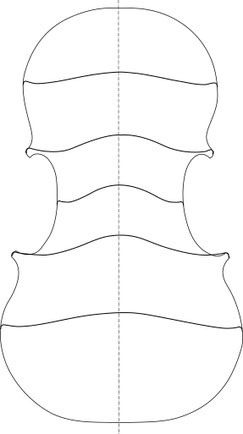
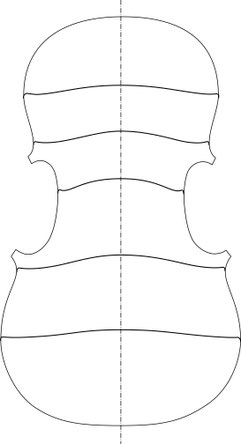
First, take a close look at the arching of your violin's top plate. Starting from the edge, the surface first dips into a shallow channel known as the fluting, before rising towards the centre after about one to three centimetres. The fluting is rather like the brim of a hat, forming a gentle trough around the edge of the instrument.
To get a sense of its depth, imagine—only imagine!—pouring a little water onto the top plate. How wide and how deep would the little moat around the edge be?
The width and depth of the fluting, together with the overall weight of the instrument, play an important role in determining how the violin responds. As a general principle, the more flexible the edge area, the more readily the instrument responds. The same is true of weight: the lighter the instrument, the quicker and more freely it can vibrate.
As you might imagine, the lower Baroque pitch, together with the use of gut strings, results in considerably lower string tension than on a modern violin. This requires a lighter and more flexible instrument.
With these ideas in mind, take a look at the drawings below.
Amati vs. Stradivari
The Amati arching features deep, broad fluting, reminds one of a beautiful mountain valley.
Compared with the Amati model, the Stradivari arching has noticeably shallower fluting.
Balancing the Sound
As you might expect, the Amati arching is inherently more flexible than the flatter Stradivari arching. But fortunately, a violin maker's life is not that simple: not every Amati copy automatically becomes an excellent baroque violin.
Arching is only one part of the equation. Leave too much thickness in the fluting area of an Amati model, and the instrument will become surprisingly stiff. On the other hand, a Stradivari model can make an excellent baroque instrument if the edge area is worked with sufficient flexibility. The choice of wood, of course, is equally important.
Nevertheless, we usually choose models with broad, deeply cut fluting, such as those by Amati or Stainer. They provide a natural starting point for the responsive, lightly built instruments we aim to create.
What about Violas?
Because of the missing E string (well, viola players do not really miss it), modern violas operate under relatively low string tension. As a result, many of the construction principles we apply to modern violas work equally well for their baroque counterparts.
The same is true when it comes to weight. Both modern and baroque violas benefit from a light, responsive construction that allows the instrument to speak freely without sacrificing depth of tone.
For this reason, there is no need to choose a different model for our baroque violas. Everything we explain here about our preferred viola models applies equally to their baroque versions.